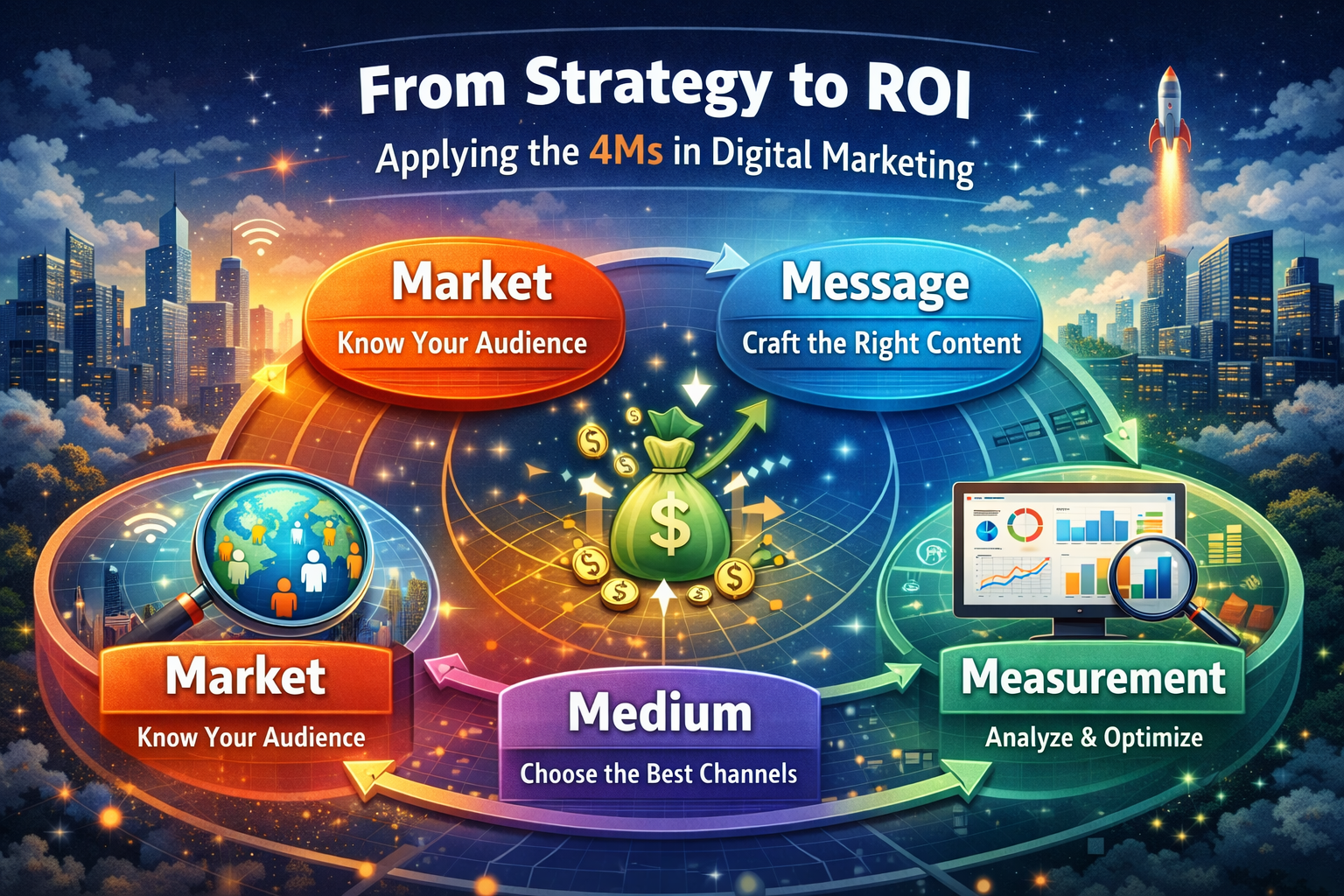
From Strategy to ROI – Applying the 4Ms in Digital Marketing
In 2026, digital marketing success is no longer defined by impressions or clicks—it is measured by real business outcomes and return on investment (ROI). With rising competition and evolving technologies, businesses must move beyond traditional strategies and adopt a more integrated, performance-driven approach. The 4M framework provides a structured pathway to transform marketing strategies into measurable results.
The Shift from Planning to Performance
Modern marketing has shifted from experimentation to ROI-focused execution. Businesses are no longer impressed by vanity metrics; instead, they prioritize conversions, revenue, and customer lifetime value.
With 93% of marketers reporting measurable ROI from AI adoption, performance tracking and optimization have become central to every strategy.
Aligning Strategy with Customer Intent
In 2026, successful strategies are built around customer intent and personalization. Generic campaigns are rapidly losing effectiveness as consumers expect tailored experiences.
- AI-driven personalization can increase sales by up to 20%
- Personalized campaigns significantly improve engagement and conversions
This means businesses must design strategies that adapt to user behavior in real time, ensuring every interaction is relevant and value-driven.
Leveraging Technology for Measurable Growth
Technology plays a crucial role in bridging the gap between strategy and ROI. AI and automation tools now enable:
- Real-time campaign optimization
- Predictive audience targeting
- Automated content and ad performance tracking
In fact, 88% of marketers use AI daily, highlighting its importance in achieving scalable and efficient results. The focus is no longer on using tools, but on integrating them effectively across the entire marketing ecosystem.
Optimizing Investment for Maximum ROI
Budget allocation has become more strategic than ever. Companies are investing heavily in high-performing areas such as personalization, with a significant portion of marketing budgets now dedicated to it.
Additionally, modern systems use predictive budget allocation, automatically shifting spend toward the best-performing channels in real time, maximizing returns.
From Campaign Execution to Conversion Optimization
The biggest transformation in 2026 is the move toward continuous optimization. Marketing is no longer a one-time campaign—it is an ongoing process of testing, analyzing, and improving.
- Conversion rate optimization (CRO)
- Data-driven decision-making
- Full customer journey tracking
This approach ensures that every marketing activity contributes directly to business growth.
Conclusion
Applying the 4M framework in today’s digital landscape means aligning strategy with performance at every level. By focusing on personalization, leveraging advanced technology, optimizing investments, and continuously refining campaigns, businesses can successfully bridge the gap between strategy and ROI.
In 2026, the brands that win are not those that market more—but those that measure, adapt, and convert more effectively.